China Supplier of Residual Current Circuit Breaker with Overcurrent Protection
Choose CDADA as your manufacturer and supplier. Based in China, we provide Residual Current Circuit Breaker with Overcurrent Protection, as well as a wide range of other low-voltage electrical equipment. We can develop professional, customized solutions tailored to your specific project requirements; our products come with a 3-year warranty and comply with various international standards.
What is an RCBO?
An RCBO (Residual Current Circuit Breaker with Overcurrent Protection) is a modular device that combines the functionalities of an MCB (Miniature Circuit Breaker) and an RCCB (Residual Current Circuit Breaker).
While an MCB only protects cables from overheating (overload) and catastrophic failure (short circuit), and an RCCB only protects humans from shock (leakage), the RCBO does it all. If a fault occurs—whether it's a massive surge from a short circuit or a tiny leak through a human body—the RCBO trips, isolating the circuit instantly. This dual capability makes it the gold standard for modern residential and commercial electrical installations.
Types and Classifications
Our RCBO manufacturing capabilities cover a wide spectrum of technical configurations to meet global market demands.
|
Type / Feature |
Specification |
Application Focus |
|
Tripping Curve |
Type B (3-5 In), Type C (5-10 In), Type D (10-20 In) |
B: Residential (lights/sockets). C: Commercial (motors/AC). D: Industrial (high inrush). |
|
Residual Current Type |
Type AC (Standard), Type A (Pulsating DC) |
Type A is increasingly standard for modern homes with electronics (washing machines, PCs, LED drivers). |
|
Technology |
Electromagnetic vs. Electronic |
Electromagnetic: High reliability, voltage-independent (safer). Electronic: Compact, cost-effective. |
|
Poles |
1P+N (Single Module/18mm), 2P (Double Module/36mm),3P+N,4P |
1P+N: Space-saving for residential. 2P: Full isolation for industrial/commercial. |
Core Functions and Protection Mechanisms
The RCBO is a marvel of miniaturization, housing two distinct protection systems within a single casing.
Overcurrent Protection (The MCB Component):
Thermal Trip: A bimetallic strip heats up and bends under sustained overload, mechanically unlatching the mechanism. This protects cables from melting.
Magnetic Trip: A solenoid coil reacts to high-current short circuits, tripping the breaker in milliseconds to prevent explosion or fire.
Residual Current Protection (The RCCB Component):
Zero-Sequence Transformer: Continuously monitors the balance between Live and Neutral currents.
Leakage Detection: If current leaks to earth (e.g., through a person), the imbalance triggers a sensitive relay that forces the contacts open.
Combined Safety: The internal mechanism is designed so that either system (thermal/magnetic OR residual) can trigger the trip latch, ensuring that no fault goes undetected.
Primary Applications and Use Cases
Residential Distribution: Protecting individual circuits (e.g., kitchen sockets, bathroom heaters) where both overload and shock protection are required in a limited panel space.
Commercial Buildings: Ensuring continuity of service. If a fault occurs on one circuit (e.g., a faulty PC), only that specific RCBO trips, rather than a main RCCB cutting power to the whole floor.
Renewable Energy (Solar PV): Protecting inverter circuits from DC injection faults and overcurrents.
Industrial Control: Protecting sensitive control circuits and motors from phase-to-ground faults.
Precision Manufacturing: From Raw Material to Finished Product
Producing an RCBO is significantly more complex than producing an MCB or RCCB separately, as it requires the perfect synchronization of two distinct mechanisms.
1. Main Raw Materials:
Housing: High-grade, flame-retardant Polyamide (PA66) or Polycarbonate to withstand the heat generated by dual protection elements.
Contact System: Silver-Tin-Oxide (AgSnO2) contacts capable of handling both high short-circuit currents and frequent leakage switching.
Magnetic Core: Permalloy or Nanocrystalline cores for the leakage detection transformer.
Trip Unit: A complex assembly combining a bimetallic strip, a solenoid coil, and a polarized magnetic relay.
2. Production & Processing Workflow:
Sub-Assembly: The MCB mechanism (thermal/magnetic) and the RCCB mechanism (transformer/relay) are assembled on separate lines.
Integration: The two systems are merged. The "trip bar" is calibrated so that the mechanical force from either the overload or the leakage detection can successfully unlatch the contacts.
Wiring: Internal flexible connectors are welded with precision to ensure low resistance and mechanical flexibility.
Dual Calibration: This is the most critical step. The unit is tested for Amperage (In) (e.g., 16A) and Leakage (IΔn) (e.g., 30mA). Both must be perfectly calibrated for the unit to pass.
Rigorous Quality Control and Testing Standards
We adhere to IEC/EN 61009-1, the international standard for RCBOs. Our testing is exhaustive because the device carries the burden of two safety functions.
Standard Test Items & Factory Inspection Criteria:
|
Test Item |
Standard Reference |
Our Factory Standard & Method |
|
Overcurrent Calibration |
Verifies thermal/magnetic trip. |
Tested at 1.13 In (no trip) and 1.45 In (trip). Magnetic trip tested at 3-5 In (Type B). |
|
Residual Current Trip |
Verifies leakage sensitivity. |
Inject 1.0 x IΔn (30mA). Must trip within 300ms. Inject 5 x IΔn (150mA). Must trip within 40ms. |
|
Short-Circuit Capacity |
Verifies breaking power. |
Icn (e.g., 6000A) test. The RCBO must break the fault without explosion. We perform sample destructive testing. |
|
Dielectric Strength |
Verifies insulation. |
Applied 2000V AC for 1 minute. No breakdown between phases or phase-to-earth. |
|
Mechanical Life |
Verifies durability. |
4,000 to 10,000 cycles (ON-OFF) to ensure the complex latch mechanism doesn't wear out. |
Our Production Prowess: Line, Equipment, and Team
Our facility is designed to handle the complexity of RCBO assembly with high precision.
Production Line: We utilize modular assembly lines that allow for the parallel assembly of MCB and RCCB components before the final integration station.
Advanced Equipment:
Dual-Channel Calibration Benches: Specialized machines that simultaneously test the overcurrent rating (Amps) and the residual current rating (mA) to ensure both systems function independently and correctly.
Automatic Welding Robots: For precise internal wiring, reducing the risk of loose connections which are critical in such a compact device.
High-Speed Cameras: Used in R&D to visualize the contact separation during a trip to optimize the linkage mechanism.
Expert Team:
Integration Engineers: Specialists in mechanical linkage design, ensuring the "trip logic" works flawlessly whether the fault is an overload or a leak.
Quality Control: Trained to identify "nuisance tripping" issues and ensure the device is immune to voltage surges that do not constitute a fault.
Choose our RCBOs. We deliver a product that offers maximum protection in minimum space, engineered for a world that demands both safety and efficiency.


- View as
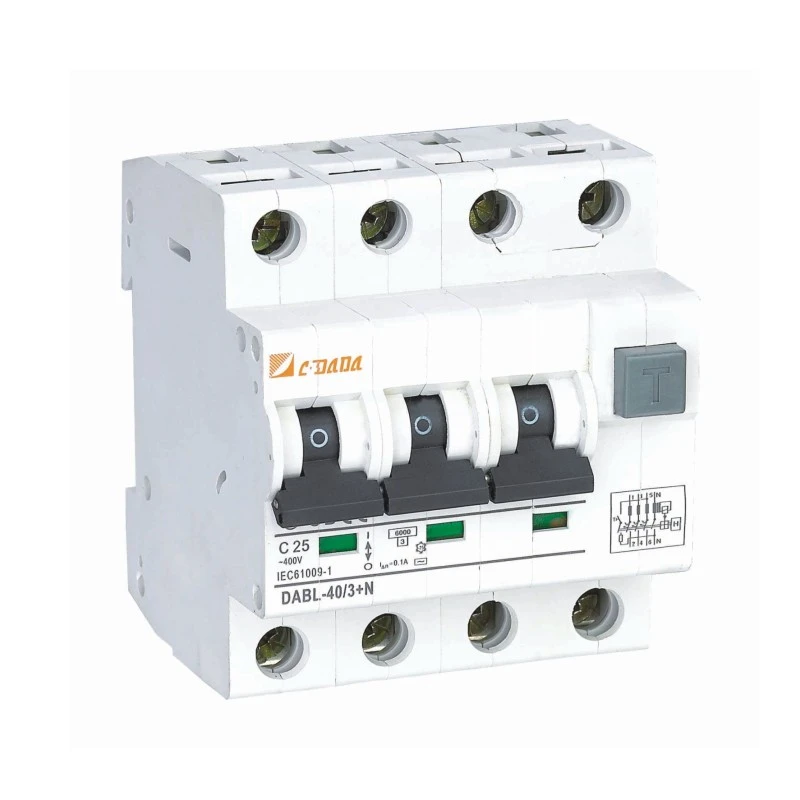
2P 4P Electronic Type RCBO
You can rest assured to choose CDADA as your 2P 4P Electronic Type RCBO (DABL-63) manufacturer and supplier. Our product is CE/CB/RoHS certified. Combines 30mA leakage + overload + short-circuit protection. 6kA, –25°C to +40°C, ideal for outdoor/garage circuits.

2P 4P Electromagnetic RCBO
Source CDADA 2P 4P Electromagnetic RCBO (DABF-63) IEC-compliant, 30mA/100mA, 6kA. Pure magnetic trip: no electronics, no auxiliary power. Ideal for unstable grids, outdoor & critical circuits. CE/CB certified. You choose CDADA as your manufacturer and supplier, and get our OEM/ODM services.
CDADA is a Residual Current Circuit Breaker with Overcurrent Protection manufacturer and supplier in China. Our factory serves diverse industries such as power systems, building automation, and industrial manufacturing, offering flexible OEM/ODM solutions.