Customized Thermal Overload Relay Factory
CDADA, a manufacturer and supplier based in China, offers a wide range of low-voltage electrical equipment, including thermal overload relays. Our technical team provides comprehensive OEM customization services as well as after-sales technical support. We welcome your inquiries.
What is a Thermal Overload Relay?
A Thermal Overload Relay is a protective device designed to switch off an electric motor when it draws too much current for a prolonged period, causing it to overheat. Unlike a fuse or a standard circuit breaker which reacts to instantaneous high current (short circuits), a TOR utilizes an inverse-time characteristic. This means the tripping time decreases as the current increases, perfectly mirroring the thermal capacity of the motor windings.
The core of our technology relies on the bimetallic strip principle: two metals with different coefficients of thermal expansion bonded together. When heated by the motor current, the strip bends. If the current exceeds the safe setting for a specific duration, the strip bends enough to mechanically trip the auxiliary contacts, cutting power to the motor starter coil.
Types and Classifications
Our manufacturing capabilities encompass the full spectrum of overload protection technologies, tailored for diverse industrial needs.
|
Type |
Key Features |
Typical Application |
|
Bimetallic Relay |
Direct or indirect heating via heater coils. Robust, simple, and cost-effective. |
General purpose motor protection (pumps, fans, conveyors). |
|
Electronic Relay |
Solid-state, no moving parts. Features precise current sensing, phase-loss detection, and ground fault protection. |
Critical processes, high-inertia loads, and hazardous environments. |
|
Solid State (SSR) |
Uses current transformers and microprocessors. Zero maintenance, extremely fast response. |
High-performance servo motors and precision machinery. |
|
Manual/Auto Reset |
Manual: Requires operator intervention to restart (safety). Auto: Resets automatically after cooling (unattended systems). |
Manual: Machines where unexpected restart is dangerous. Auto: HVAC, pumps in remote locations. |
Core Functions and Intelligent Protection
Our Thermal Overload Relays are not just simple switches; they are intelligent guardians of the motor.
● Overload Protection: The primary function. By integrating the current over time ( I2tI2t ), the relay protects the motor insulation from thermal degradation. It allows for temporary inrush currents (starting the motor) without nuisance tripping but reacts decisively to sustained overloads.
● Phase Failure Protection (Single Phasing): In a three-phase system, if one phase is lost, the motor draws excessive current on the remaining two phases to maintain torque. Our relays feature a differential mechanism (or electronic sensing) that detects this imbalance and trips instantly, preventing the motor from burning out.
● Temperature Compensation: A critical feature for industrial environments. Our relays are equipped with a compensating bimetallic strip that counteracts the effects of ambient temperature changes. This ensures the trip point remains accurate whether the panel is in a freezing warehouse or a hot factory floor (-20°C to +60°C).
Trip Class Selection
We manufacture relays conforming to standard trip classes:
◆ Class 10: For low thermal capacity motors (e.g., submersible pumps).
◆ Class 10A/20: Standard for general industrial motors.
◆ Class 30: For high-inertia loads (e.g., large fans, centrifuges) that take longer to start.
◆ Primary Applications and Use Cases
◆ Industrial Manufacturing: Protecting conveyor belts, robotic arms, and CNC machine spindles from jamming or overloading.
◆ HVAC Systems: Safeguarding large centrifugal fans and compressor motors in commercial buildings.
◆ Water Treatment: Essential for protecting submersible pumps and aerators from running dry or clogging.
◆ OEM Machinery: Integrated into control panels for packaging machines, textile looms, and food processing equipment.
Precision Manufacturing
Our production process is a masterclass in thermal engineering and mechanical precision.
1. Main Raw Materials:
◆ Bimetallic Strips: The heart of the device. We use high-grade alloys (e.g., Nickel-Iron/Manganese-Copper) with precisely calculated expansion coefficients to ensure consistent bending at specific temperatures.
◆ Heater Elements: Precision-wound resistance wire (Nichrome) or heavy-duty copper bars that generate heat proportional to the square of the current ( I2RI2R ).
◆ Contacts: Silver-Nickel (AgNi) or Silver-Cadmium-Oxide (AgCdO) for the auxiliary contacts (NC/NO), ensuring reliable signaling to the PLC or contactor.
◆ Housing: High-strength, flame-retardant Polyamide (PA66) or Bakelite, designed to withstand high thermal stress.
2. Production & Processing Workflow:
◆ Component Fabrication: Precision stamping of the bimetallic strips and heater coils.
◆ Calibration: The most critical step. The relay is passed through a high-current calibration tunnel. Technicians adjust the "current setting dial" to mechanically pre-stress the bimetallic strip, ensuring it trips at the exact amperage (e.g., 10A, 16A).
◆ Assembly: The bimetallic strip, heater, and trip mechanism (including the differential lever for phase loss protection) are assembled with microscopic tolerances.
◆ Potting (Optional): For harsh environments, the internal mechanism is encapsulated in epoxy resin to prevent corrosion and vibration damage.
◆ Rigorous Quality Control and Testing Standards
We adhere to IEC/EN 60947-4-1 and GB/T 14048.4 standards. Our quality assurance protocols are designed to ensure the relay mimics the motor's thermal curve perfectly.
Standard Test Items & Factory Inspection Criteria:
|
Test Item |
Standard Reference |
Our Factory Standard & Method |
|
Trip Class Verification |
Verifies the time-current curve. |
Tested at 7.2 x Rated Current. Class 10 must trip in < 10s; Class 20 in < 20s. |
|
Cold State Calibration |
Verifies accuracy from a cold start. |
Current raised to 1.05 x Setting. Must NOT trip in < 2 hours. Then raised to 1.2 x Setting. Must trip in < 2 hours. |
|
Phase Failure Test |
Verifies single-phase protection. |
One phase current set to 0, others at rated current. Relay must trip within a specific time (e.g., < 2 mins). |
|
Ambient Temp Compensation |
Verifies stability in heat/cold. |
Tested in a climate chamber at -20°C and +60°C. Trip point variation must be < ±5%. |
|
Mechanical Life |
Verifies durability. |
1,000 to 10,000 cycles of manual reset and trip operations without mechanical failure. |
Our Production Prowess
Our facility is equipped to handle the delicate physics of thermal management.
◆ Production Line: We utilize semi-automated assembly lines specifically designed for the sensitive handling of bimetallic strips, preventing mechanical stress that could alter their thermal properties.
Advanced Equipment:
◆ High-Current Calibration Benches: Capable of injecting up to 1000A to simulate heavy overloads and verify trip times with millisecond accuracy.
◆ Environmental Climate Chambers: Used to test the temperature compensation mechanism across the full industrial temperature range.
◆ Laser Welding Stations: For creating robust, low-resistance connections between heater elements and terminals.
Expert Team:
◆ Thermal Engineers: Specialists in heat transfer and material science who design the bimetallic geometry.
◆ Calibration Technicians: Highly skilled staff who fine-tune the trip mechanisms to ensure every relay meets the strict Class 10A/20/30 standards.
◆ Quality Assurance: Dedicated to analyzing the "trip curve" consistency to prevent nuisance tripping in the field.
Choose our Thermal Overload Relays. We don't just manufacture components; we engineer the reliability that keeps your motors running and your production lines moving.


- View as

LRD Thermal Overload Relay
CDADA's LRD Thermal Overload Relay is a high performance product, 0.1–104A, CE compliant, with phase-loss, stall & long-start protection. Manual/auto reset, test button, and contactor-compatible (D09–D95). Ideal for motor safety in industrial control. Contact us for a factory quotation.
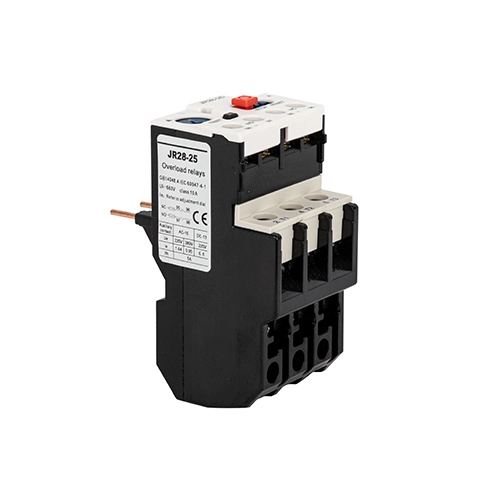
JR28 Thermal Overload Relay
CDADA is a professional manufacturer of advanced JR28 Thermal Overload Relay, 0.1–140A, CE compliant, with phase-loss, stall & long-start protection. Manual/auto reset, test button, and compatible with D9–D150 contactors. If you need OEM/ODM services, or want to get technical support, please contact us.
CDADA is a Thermal Overload Relay manufacturer and supplier in China. Our factory serves diverse industries such as power systems, building automation, and industrial manufacturing, offering flexible OEM/ODM solutions.