High-Quality DC Circuit Breaker Manufacturer
CDADA is a reliable manufacturer and supplier of DC circuit breakers. Our products are high-quality, dependable, and technologically advanced. We specialize in developing tailored solutions for industries such as new energy, providing you with comprehensive, one-stop OEM services.
What Is a DC Circuit Breaker?
A DC circuit breaker is a specialized protective device designed to interrupt direct current (DC) circuits under overload, short-circuit, or fault conditions. Unlike AC circuit breakers that benefit from natural current zero-crossings (100-120 times per second at 50/60Hz), DC breakers must forcibly extinguish a continuous, unidirectional arc that lacks inherent self-extinguishing properties. This fundamental difference necessitates sophisticated arc quenching technologies, making DC breakers physically larger, more complex, and more expensive than their AC counterparts .
DC circuit breakers operate across voltage ranges from 12V to 1500V DC, with current ratings spanning 2A to 2500A. They serve as critical protection components in solar photovoltaic (PV) systems, battery energy storage systems (BESS), electric vehicle (EV) charging infrastructure, data centers with DC power distribution, industrial DC motor controls, and marine electrical systems .
The core challenge in DC interruption lies in arc extinction physics: DC arcs maintain stable plasma columns with temperatures exceeding 10,000°C, requiring forced elongation, cooling, and deionization through magnetic fields, arc chutes, and specialized contact materials .
Product Categories & Configurations
|
Classification |
Type |
Current/Voltage Range |
Key Characteristics |
|
By Construction |
2A – 125A, 250V – 1000V DC |
DIN rail mounting, fixed trip settings, residential/commercial PV |
|
|
10A – 2500A, 500V – 1500V DC |
Adjustable trip units, high breaking capacity, industrial/utility |
||
|
630A – 6300A, 1000V DC |
Draw-out design, electronic protection, power distribution |
||
|
Solid-State DC Breaker |
100A – 5000A, up to 1500V DC |
Semiconductor-based, <1ms operation, no arcing, premium cost |
|
|
By Voltage Rating |
Low Voltage |
12V – 250V DC |
Automotive, marine, telecommunications |
|
Medium Voltage (PV Standard) |
250V – 1000V DC |
Solar PV strings, combiner boxes, residential/commercial |
|
|
High Voltage |
1000V – 1500V DC |
Utility-scale PV, battery storage, EV fast charging |
|
|
By Pole Configuration |
1-Pole |
250V DC |
Single-string PV, low-voltage DC |
|
2-Pole (Series) |
500V – 750V DC |
Mid-voltage PV, dual-pole series connection |
|
|
3-Pole |
750V DC |
Three-phase DC systems, specialized industrial |
|
|
4-Pole (Series) |
1000V – 1500V DC |
High-voltage PV, battery racks, EV infrastructure |
|
|
By Trip Technology |
Thermal-Magnetic |
2A – 800A |
Bimetallic overload + solenoid short-circuit, economical |
|
Electronic |
100A – 2500A |
Microprocessor-based, adjustable curves, communication |
|
|
Magnetic Only |
10A – 100A |
Short-circuit only, motor protection, fast operation |
Critical Designation: Polarity Sensitivity DC breakers must be marked with positive (+) and negative (-) terminals, with current direction indicators. Reverse polarity installation can result in catastrophic failure due to asymmetric arc behavior .
Core Functions & Operating Principle
The DC Arc Challenge
Unlike AC arcs that extinguish naturally at current zero-crossings, DC arcs present unique extinguishing challenges:
|
Parameter |
AC Arc |
DC Arc |
|
Current waveform |
Sinusoidal, zero-crossings every 10ms (50Hz) |
Continuous, constant magnitude |
|
Arc voltage |
Fluctuates with current |
Stable, requires forced extinction |
|
Arc extinction |
Natural at zero-crossing |
Forced elongation + cooling required |
|
Arc energy |
Pulsed, lower average |
Continuous, concentrated heat |
|
Contact wear |
Moderate |
Severe without proper quenching |
|
Required gap |
Smaller |
2-3× larger for equivalent voltage |
Arc Extinction Technologies
|
Technology |
Mechanism |
Application |
Performance |
|
Magnetic Blowout |
Lorentz force F = I × L × B drives arc into splitter plates at 50-200 m/s |
Universal for DC MCB/MCCB |
Most common, cost-effective, 10-20kA breaking |
|
Arc Chute with Splitter Plates |
Arc divided into series segments, cooled, deionized |
Standard in all DC breakers |
Essential component, voltage drop per plate 30-50V |
|
Permanent Magnets |
NdFeB magnets (0.1-0.3T) perpendicular to arc path |
Compact DC MCBs |
No external power, temperature-stable to 150°C |
|
Electromagnetic Blowout Coil |
Self-energized coil generates field proportional to fault current |
High-current MCCBs |
Force increases with current, adaptive protection |
|
Vacuum Interruption |
Arc extinguished in vacuum (no ionizable medium) |
High-voltage DC, specialized |
Excellent for >1000V DC, long life, expensive |
|
Air Blast |
Compressed air cools and stretches arc |
High-power industrial, legacy |
High maintenance, rarely used in modern designs |
Magnetic Blowout Physics
The Lorentz force equation governs DC arc manipulation:
F = I × L × B
Where:
F = Force on arc (Newtons)
I = Arc current (Amperes)
L = Arc length (meters)
B = Magnetic flux density (Tesla)
Example Calculation:
Arc current: 1000A
Arc length: 0.02m (2cm)
Magnetic field: 0.2T
Force: F = 1000 × 0.02 × 0.2 = 4N
Acceleration: a = 4N / (5×10⁻⁴ kg/m × 0.02m) = 400,000 m/s²
This enormous acceleration drives the arc into splitter plates within milliseconds, where it is segmented, cooled, and extinguished.
Application Environments & Use Cases
|
Industry Sector |
Specific Application |
Typical Specifications |
Critical Requirements |
|
Solar PV (Residential) |
String protection, combiner boxes |
10A-32A, 250V-500V DC, 2-pole, Type C curve |
UV resistance, IP65 enclosure, 20kA Icu |
|
Solar PV (Commercial) |
Combiner box main, inverter protection |
63A-125A, 500V-1000V DC, 4-pole, 10-20kA Icu |
High ambient (60°C), reverse current withstand |
|
Solar PV (Utility) |
Central inverter, DC collection |
250A-800A, 1000V-1500V DC, DC MCCB, 50kA Icu |
Selective coordination, remote monitoring |
|
Battery Energy Storage |
Battery rack protection, DC bus |
125A-630A, 750V-1500V DC, electronic trip, 4-pole |
Bidirectional protection, high short-circuit current |
|
EV Charging |
DC fast charger protection, battery interface |
200A-400A, 500V-1000V DC, high endurance |
Frequent operation, high inrush, SIL 2 safety |
|
Data Centers |
380V DC distribution, UPS protection |
63A-250A, 380V DC, high breaking, low energy let-through |
Minimal downtime, selective coordination |
|
Rail Traction |
Metro, tram, railway DC supply |
1000A-4000A, 750V-1500V DC, DC ACB |
High mechanical endurance, vibration resistance |
|
Marine/Offshore |
Ship DC distribution, offshore platforms |
100A-400A, 500V DC, corrosion-resistant |
Salt spray, tropicalized, redundant tripping |
Manufacturing Process & Production Workflow
Precision Manufacturing Sequence
Raw Material IQC → Contact System Fabrication → Arc Chute Assembly → Magnetic System Integration → Mechanism Assembly → Trip Unit Calibration → Primary Assembly → High-Current Testing → Final QC → Packaging
Critical Manufacturing Stages
|
Stage |
Process Details |
Quality Control Points |
|
Contact Fabrication |
Silver-tungsten (AgW 70/30) or copper-tungsten (CuW 80/20) contact tips, brazing to copper carriers, wiping geometry forming |
Hardness HV 120-180, arc erosion resistance, contact resistance <1mΩ, brazing strength >80MPa |
|
Arc Chute Construction |
Ceramic splitter plates (6-15 plates depending on voltage), steel arc runners, permanent magnet integration, optimized arc chamber geometry |
Dielectric strength >3kV, arc quenching time <10ms, magnetic flux density 0.15-0.25T |
|
Magnetic Blowout System |
NdFeB permanent magnet placement (N52 grade), pole piece machining, magnetic circuit optimization, temperature compensation |
Flux density ±10% tolerance, temperature coefficient -0.1%/°C, demagnetization resistance |
|
Mechanism Assembly |
Quick-make/quick-break toggle, spring energy storage, trip-free linkage, contact pressure springs |
Contact opening speed >1.2 m/s, mechanical endurance 20,000 cycles, trip time <20ms |
|
Trip Unit Calibration |
Bimetallic thermal element calibration (±5% accuracy), magnetic solenoid gap setting, time-current curve verification |
1.05×In no-trip, 1.25×In trip <1h, 5×In instantaneous, data logging |
|
High-Current Testing |
Primary injection testing at 10kA-20kA, arc extinction verification, temperature rise measurement |
Breaking capacity verification, contact wear <5% after test, dielectric recovery |
Primary Raw Materials & Component Specifications
|
Component |
Material Specification |
Supplier Standards |
Key Properties |
|
Main Contacts |
Silver-tungsten (AgW 70/30) or copper-tungsten (CuW 80/20) |
ASTM B702, IEC 60368 |
High arc erosion resistance, anti-welding, conductivity 45-55% IACS |
|
Arc Chute Plates |
Alumina ceramic (Al₂O₃ 95%) or steatite |
IEC 60672 |
Heat resistance >1200°C, dielectric strength >15kV/mm, arc quenching |
|
Permanent Magnets |
NdFeB N52 (Neodymium-Iron-Boron) |
IEC 60404-8-1 |
Remanence 1.48T, coercivity >1000kA/m, temperature stable to 150°C |
|
Magnetic Pole Pieces |
Low-carbon steel 1008 or silicon steel |
ASTM A1008 |
High permeability, low remanence, magnetic flux guidance |
|
Moulded Case |
BMC (DMC-2) thermosetting or PA66 GF30 |
IEC 60664-1, UL 94 V-0 |
Tracking index >600V, heat resistance 180°C, arc containment |
|
Contact Springs |
Beryllium copper (CuBe2) or stainless steel 301 |
ASTM B196 |
Fatigue life >50,000 cycles, consistent pressure, corrosion resistance |
|
Terminals |
Copper C11000 with tin or silver plating |
ASTM B187 |
Current density 1.5-2.0 A/mm², low contact resistance, oxidation resistance |
|
Bimetallic Elements |
Inconel/passivated steel composite |
ASTM B388 |
Deflection rate 0.2mm/°C, stability ±3%, calibration accuracy ±5% |
|
Electronic Components (for electronic trip units) |
Industrial-grade PCBs, Hall sensors, ARM processors |
IEC 60721-3-3 |
-25°C to +70°C operation, EMC Level 3, SIL 2 capable |
Standards Compliance & Testing Protocols
International Standards Framework
|
Standard |
Scope |
Applicable Ratings |
|
IEC 60947-2 |
Low-voltage switchgear - Circuit-breakers (includes DC) |
Universal standard for DC breakers up to 1500V DC |
|
IEC 60898-2 |
Circuit breakers for DC operation (household) |
DC MCBs up to 125A, 220V DC (1-pole), 440V DC (2-pole) |
|
IEC 61643-31 |
SPDs for photovoltaic applications |
DC surge protection coordination with breakers |
|
GB/T 14048.2 |
Chinese national standard |
CCC certification for China market |
Critical DC Testing Requirements:
Critical DC load current test: Verification of cut-off current where arcing time increases significantly
Short-circuit breaking capacity: Tested at maximum DC voltage with specified time constant (L/R ratio)
Overload performance: Verification of thermal trip at 1.45×In for 1 hour
Mandatory Type Tests (IEC 60947-2 for DC)
|
Test Category |
Specific Test |
Acceptance Criteria |
|
Temperature Rise |
Continuous current at rated In |
Terminals ≤80K (silver), ≤65K (bare), case ≤40K |
|
Dielectric Properties |
Power-frequency withstand (2.5kV-3.5kV/1min), impulse (8kV) |
No breakdown, no flashover |
|
Tripping Characteristics |
Overload: 1.05×In (no trip), 1.25×In/1.45×In (trip within limits) |
Conventional tripping times per curve |
|
|
Short-circuit: 5×In, 10×In instantaneous trip |
<20ms operation |
|
Operational Performance |
Mechanical: 20,000 cycles; Electrical: 10,000 cycles |
<5% parameter drift |
|
Short-Circuit Breaking |
Icu (ultimate), Ics (service) at rated DC voltage |
Successful interruption, no contact welding |
|
Critical DC Load Current |
Verification of arcing time limits |
No excessive arcing within rated range |
|
Magnetic Blowout Verification |
Arc extinction time, arc chamber integrity |
<10ms arc duration, no chamber breach |
|
Environmental |
Damp heat, cold, dry heat, vibration |
Functional after conditioning |
Factory Quality Control & Inspection Standards
Incoming Material QC (IQC)
|
Material |
Inspection Items |
Sampling Plan |
Equipment |
|
Tungsten contact tips |
Density, hardness, silver content, dimensional tolerance |
Per batch |
Spectrometer, hardness tester, CMM |
|
NdFeB magnets |
Remanence, coercivity, temperature coefficient, plating |
Per batch |
Hysteresisgraph, Helmholtz coil |
|
Ceramic plates |
Dielectric strength, thermal shock resistance, dimensions |
Per batch |
Dielectric tester, thermal shock chamber |
|
Copper carriers |
Conductivity, hardness, plating thickness |
Per batch |
Conductivity meter, micrometer, XRF |
|
Thermosetting plastic |
Glass content, viscosity, cure time, flammability |
Per batch |
DSC, melt flow indexer, UL 94 apparatus |
In-Process Quality Control (IPQC)
|
Station |
Control Parameters |
Frequency |
Method |
|
Contact brazing |
Temperature 800-850°C, atmosphere, joint strength |
Every 100 units |
Thermocouple, shear tester, metallography |
|
Magnet placement |
Polarity verification, flux density, alignment |
Every unit |
Flux meter, vision system |
|
Arc chute assembly |
Plate spacing, magnet alignment, runner geometry |
Every 50 units |
Go/no-go gauges, flux density mapping |
|
Mechanism calibration |
Opening speed, contact pressure, trip force |
Every unit |
High-speed camera, force gauge, automated bench |
|
Trip unit testing |
Time-current curve, instantaneous trip, ambient compensation |
Every unit |
Primary injection tester (10,000A), data logging |
Final Quality Control (FQC) & Outgoing QC (OQC)
|
Test Item |
Standard |
Sample Size |
|
Polarity marking verification |
Correct +/-/current direction marking |
100% |
|
Contact resistance |
<1mΩ per pole |
100% |
|
Dielectric withstand voltage |
2.5kV AC/1min |
100% |
|
Insulation resistance |
>100MΩ @ 500V DC |
100% |
|
Tripping characteristics |
1.05×In, 1.25×In, 5×In, 10×In verification |
100% |
|
Magnetic blowout function |
Arc extinction test at rated current |
100% |
|
Mechanical operation |
10 ON-OFF cycles, smooth operation |
100% |
|
Visual & dimensional inspection |
Clearance, creepage, marking permanence |
100% |
|
High-current sampling |
Breaking capacity verification (10kA) |
AQL 0.65 |
|
Packaging integrity |
Drop test, vibration (ISTA 3A) |
Per lot |
Production Infrastructure & Manufacturing Capability
Advanced Production Equipment
|
Equipment Category |
Machine Specification |
Function |
Capacity |
|
Contact Fabrication |
Vacuum brazing furnace (10⁻³ mbar, 900°C) |
Tungsten-silver contact brazing |
5,000 contacts/day |
|
Magnet Assembly |
Automated magnet placement with polarity detection |
NdFeB magnet integration, flux verification |
3,000 assemblies/day |
|
Arc Chute Production |
Ceramic plate pressing, firing, metallization |
Splitter plate manufacturing |
10,000 plates/day |
|
Mechanism Assembly |
Labor assembly cells |
High-speed assembly, calibration |
2,000 units/day per line |
|
Testing Equipment |
Primary injection test set (20,000A DC capacity) |
High-current trip verification |
300 units/day |
|
Arc extinction test chamber (high-speed imaging) |
Arc behavior analysis, blowout verification |
50 units/day |
|
|
Environmental test chamber (temperature, humidity, vibration) |
IEC 60068-2 compliance |
100 units/day |
Production Capacity & Lead Times
|
Product Category |
Monthly Capacity |
Standard Lead Time |
Urgent Order Capability |
|
DC MCB 1P/2P (10A-63A, 250V-500V) |
200,000 units |
4-5 weeks |
5 days |
|
DC MCB 4P (63A-125A, 1000V) |
100,000 units |
4-5 weeks |
7 days |
|
DC MCCB (125A-400A, 500V-1000V) |
30,000 units |
4-5 weeks |
10 days |
|
DC MCCB (630A-1600A, 1000V-1500V) |
10,000 units |
4-5 weeks |
2 weeks |
|
High-voltage DC (1500V+, specialized) |
Project basis |
8-12 weeks |
4 weeks |
Engineering & Technical Team Structure
|
Department |
Personnel |
Expertise |
Responsibilities |
|
R&D Engineering |
5 engineers |
DC arc physics, magnetic field simulation, contact materials, power electronics |
New DC breaker development, patent portfolio (35+ patents), HVDC innovation |
|
Process Engineering |
20 engineers |
Vacuum brazing, magnet assembly, ceramic processing, automation |
Production optimization, yield improvement (>98%), Industry 4.0 integration |
|
Testing & Validation |
15 engineers |
High-current DC testing, arc extinction analysis, environmental simulation, EMC |
Type testing coordination (IEC 60947-2), failure analysis, certification |
|
Application Engineering |
12 engineers |
Solar PV design, battery storage systems, EV charging, DC microgrids |
Customer technical support, system design, selective coordination |
|
Quality Assurance |
30 technicians |
ISO 9001, ISO 14001, statistical process control, metrology laboratory |
Supplier audit, process audit, corrective action, calibration management |
Why Our DC Circuit Breaker Manufacturing Stands Apart
Our production facility represents 15 years of specialization in DC circuit protection, delivering breakers that exceed global standards through:
Arc physics expertise: Proprietary magnetic blowout designs with optimized Lorentz force geometry, achieving <10ms arc extinction at 1500V DC
Vertical integration: In-house tungsten-silver contact brazing, NdFeB magnet assembly, and ceramic arc chute manufacturing ensuring complete quality control
Testing infrastructure: $4M+ invested in high-current DC laboratories capable of 20,000A interruption testing, arc extinction high-speed imaging (100,000 fps), and environmental simulation
Renewable energy focus: Specialized designs for solar PV (1000V-1500V), battery storage (bidirectional protection), and EV charging (high inrush withstand)
Solid-state innovation: Development of semiconductor-based DC breakers for <1ms operation in critical battery protection applications
For technical specifications, solar PV protection coordination, battery storage system design, or factory audit scheduling, our engineering team provides direct consultation to ensure your DC power systems meet both safety requirements and operational reliability objectives.


- View as
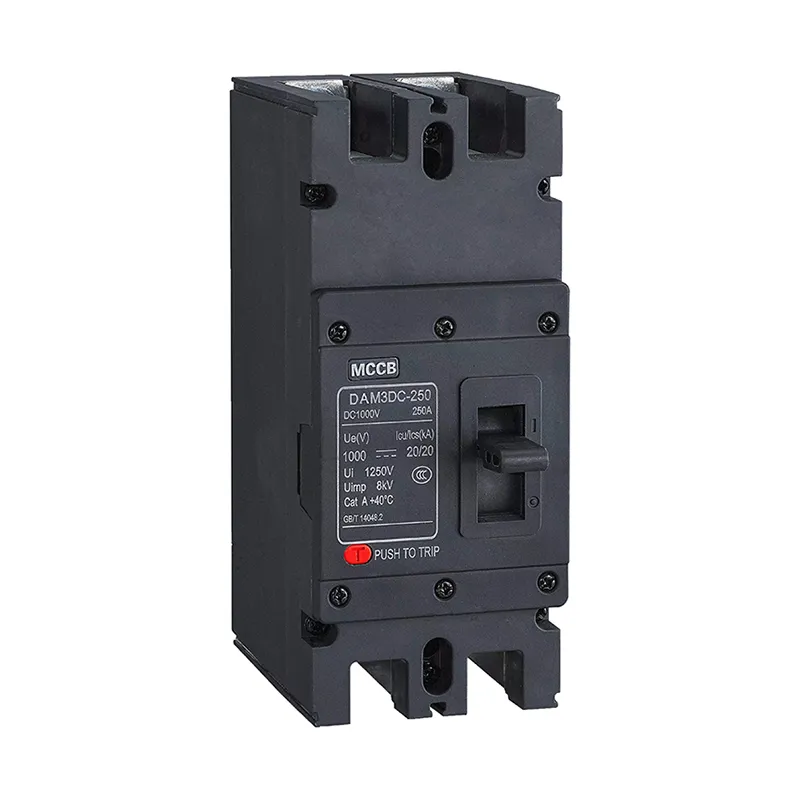
1000V DC Moulded Case Circuit Breaker
CDADA is a reliable manufacturer in China, can offer 1000V DC Moulded Case Circuit Breaker worldwide. It is up to 800A, IEC-compliant, for solar PV & DC grids. 2P/4P options, 20–40kA breaking, with isolation & accessories. DIN or panel mount. Trusted by global solar integrators.
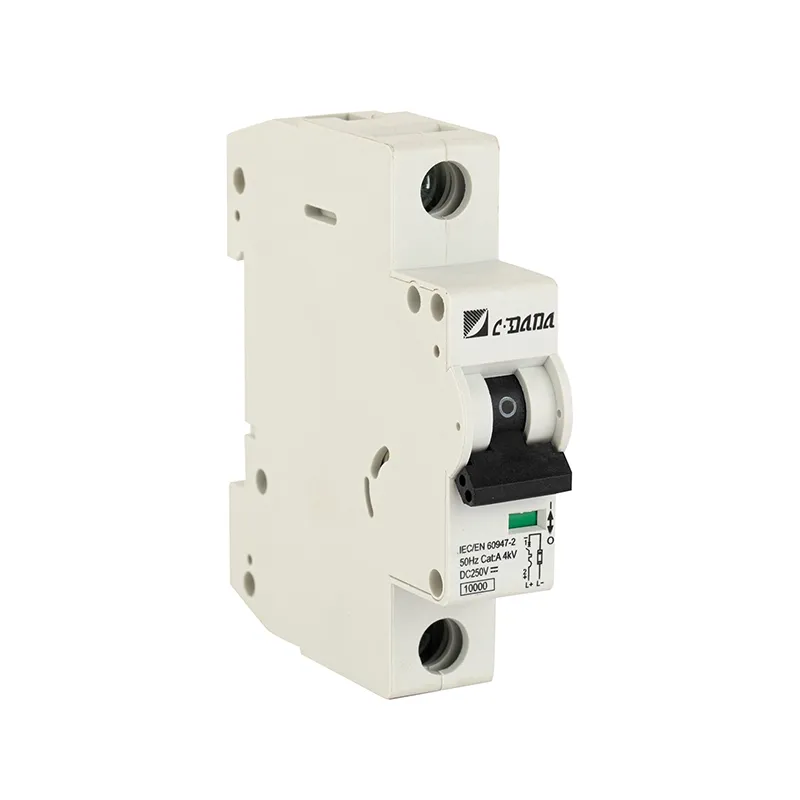
250V DC Miniature Circuit Breaker
CDADA is a good choice to be your supplier of DAB7-63 250V DC Miniature Circuit Breaker 1P, 1–63A, with 6kA breaking capacity. This product is ideal for solar PV, telecom & DC systems. DIN-rail mounted, with clear ON/OFF indicator and RoHS compliance. Please contact us to get a factory direct price.
CDADA is a DC Circuit Breaker manufacturer and supplier in China. Our factory serves diverse industries such as power systems, building automation, and industrial manufacturing, offering flexible OEM/ODM solutions.