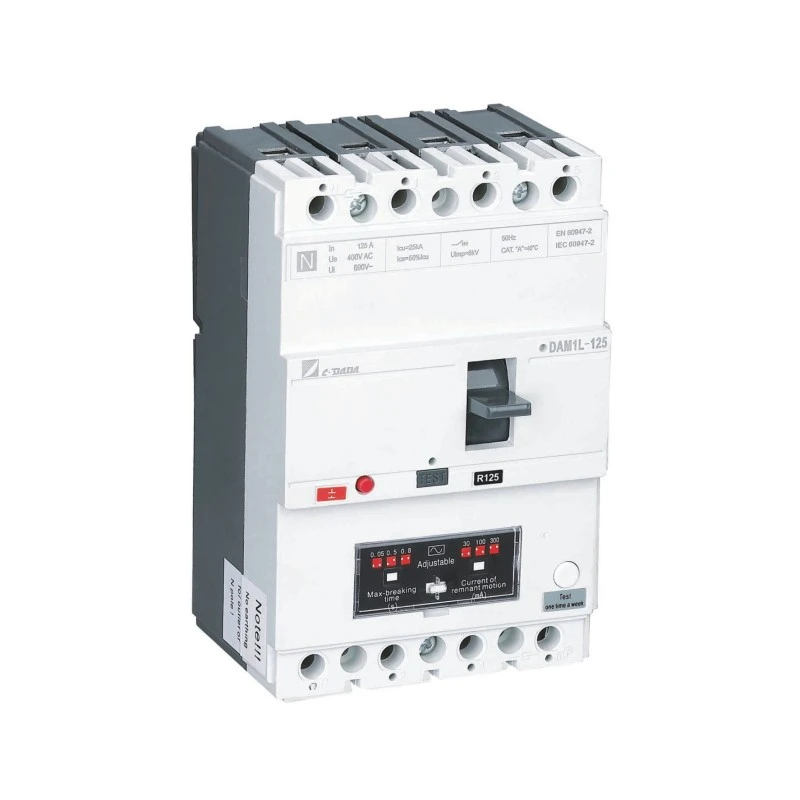
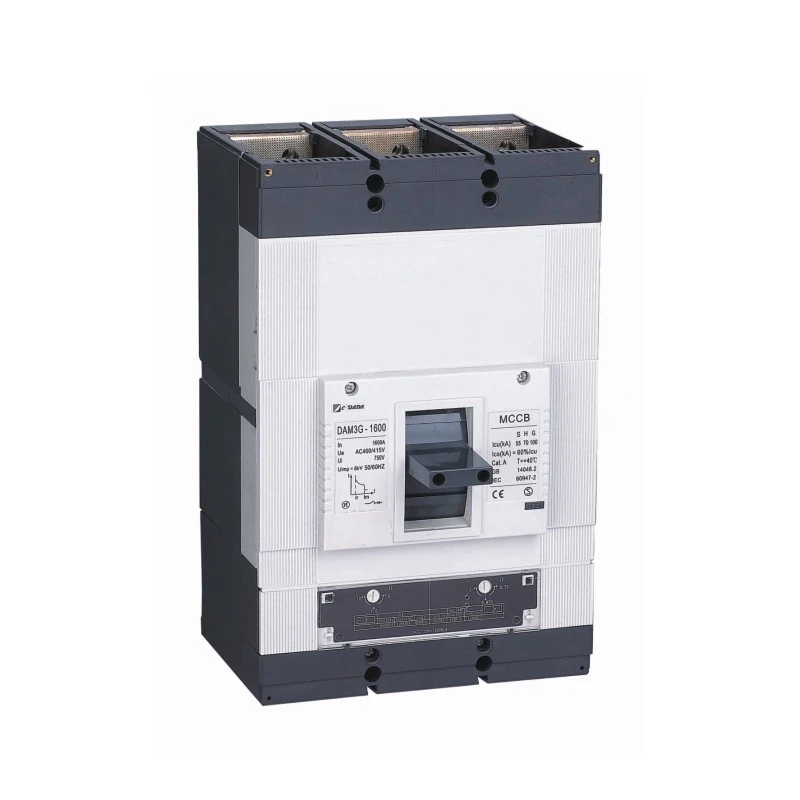
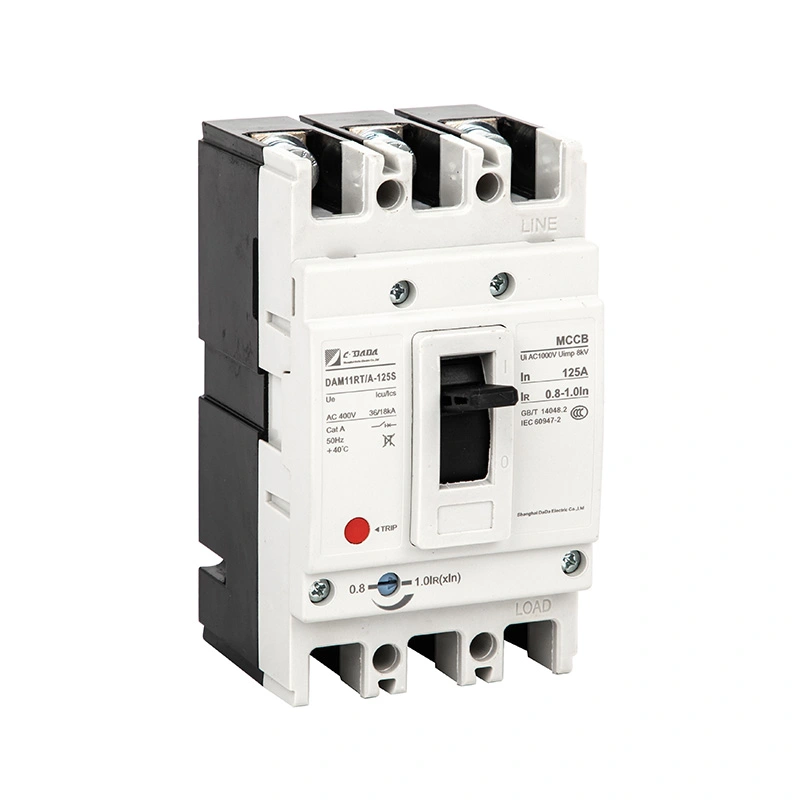
Fixed Type Moulded Case Circuit Breaker
Model:DAM1 Series
Source high quality and advanced Fixed Type Moulded Case Circuit Breaker (MCCB) from Shanghai DADA Electric—certified (CE, CB, ASTA), thermal-magnetic protection, 12.5A–1600A. Ideal for industrial & commercial panels. Easy DIN-rail or panel mount. OEM & bulk orders welcome, choose CDADA as your supplier with confidence.
CDADA Fixed Type Moulded Case Circuit Breaker (MCCB) DAM1 series meet the needs of any application, from small users to industrial transformer and distribution installation.
The DAM1 series have seven frame sizes, up to 1600A, breaking capacity up to 100 kA, operating voltage up to 1000 Volts, easily meet a variety of comprehensive electrical and mechanical accessories needs, provide a variety of installation solutions to maximize the needs of any power system.
With global certification KEMA, ASTA, SEMKO, CB, CE, ROHS; DAM1 is the best choice for worldwide electrical appliance plants and OEM.

Key Specifications
Electrical parameters of DAM1 MCCB molded case circuit breaker
| Model | code | Icu (KA) | Ics (KA) | Rated Current -In | Ui(V) | Ue(V) | Pole | Uimp(V) |
| DAM1-160 | B | 25 | 18.75 | 10 - 12,5 - 16 - 20 - 25 - 32 - 40 - 50 - 63- 80 - 100 - 125-160A | 500V | 230V | 1P | 10000 |
| N | 36 | 27 | ||||||
| DAM1-200 | B | 25 | 18.75 | 10 - 12,5 - 16 - 20 - 25 - 32 - 40 - 50 - 63- 80 - 100 - 125-160(200)A | 750V | 400V | 2P | 10000 |
| N | 36 | 27 | ||||||
| DAM1-125 | B | 25 | 12.5 | 10 - 12,5 - 16 - 20 - 25 - 32(30) - 40 - 50 - 63(60) - 80 - 100 - 125A | 750V | 400V | 3P / 4P | 10000 |
| N | 35 | 17.5 | ||||||
| S | 50 | 37.5 | ||||||
| DAM1-160 | B | 25 | 12.5 | 10- 12,5-16-20 - 25 - 32 - 40 - 50 - 63 - 80 - 100 -125 - 160(150)A | 750V | 400/415V | 3P / 4P | 8000 |
| N | 35 | 26.25 | ||||||
| S | 50 | 37.5 | ||||||
| DAM1-250 | N | 35 | 26.25 | 63 - 80-100-125 - 160(180) - 200(225) - 250(320)A | 750V | 400/415V | 3P /4P | 8000 |
| S | 50 | 37.5 | ||||||
| H | 65 | 48.75 | ||||||
| G | 85 | 51 | ||||||
| DAM1-630(400) | N | 35 | 26.25 | 250 - 315 (350)- 400 - 500 - 630A | 750V | 400/415V | 3P /4P | 8000 |
| S | 50 | 37.5 | ||||||
| H | 70 | 52.5 | ||||||
| G | 85 | 52.5 | ||||||
| DAM1-800 | N | 35 | 35 | 400 - 500 - 630 (700)- 800 -1000A | 750V | 400/415V | 3P /4P | 8000 |
| S | 50 | 37.5 | ||||||
| H | 70 | 52.5 | ||||||
| G | 85 | 52.5 | ||||||
| DAM1-1600 | S | 65 | 50 | 800 -1000 - 1250 - 1600A | 750V | 400V | 3P / 4P | 8000 |
| H | 85 | 50 | ||||||
| G | 100 | 50 |
● Icu:O-t-CO test(O:Open maneuver,CO:Close-Open maneuver,t:Waiting duration)
● Ics:O-t-CO-t-CO test(O:open maneuver,CO:Close-Open maneuver,t:Waiting duration)
★ ON/I Position: It indicates that contacts of the breaker are closed. In this position, the breaker lever is in the top position
★ TRIP Position: It indicates that the breaker is opened due to any failure (over load or short circuit). In this case, breaker lever is in the middle position between ON and OFF positions. In order to take the breaker, which is in trip position, to ON position; push the breaker lever downwards as shown by the OFF sign
Breaker shall be set with "click" sound.After that, pull the lever as shown by ON sign to close the breaker
★ OFF/0 Position: It indicates that contacts of the breaker are open. In this way, the breaker lever is in the bottom position.
Physical parameters of DAM1-125 MCCB molded case circuit breaker
| Category (EN 60947-2/IEC 60947-2) | Endurance |
|
||||||
| Model | Pole | Dielectric Propery (V) | lonization distance (mm) | Total Cycles | Electrical Life | Mechanical Life | Main circuit | Auxiliary circuit |
| DAM1-160 | 1P | 2500 | ≤30/0 | 20000 | 3000 | 17000 | A/0 | AC-15 |
| DAM1-200 | 2P | 2500 | ≤30/0 | 15000 | 2500 | 12500 | A/0 | AC-15 |
| DAM1-125 | 3P / 4P | 2500 | ≤30/0 | 8000 | 1000 | 7000 | A/0 | AC-15 |
| DAM1-160 | 3P / 4P | 3000 | ≤30/0 | 8000 | 1000 | 7000 | A/0 | AC-15 |
| DAM1-250 | 3P /4P | 3000 | ≤30/0※ | 8000 | 1000 | 7000 | A/B | AC-15 |
| DAM1-630(400) | 3P /4P | 3000 | ≤60/0※ | 5000 | 1000 | 4000 | A/B | AC-15 |
| DAM1-800 | 3P /4P | 3000 | ≤80/0※ | 5000 | 1000 | 4000 | A/B | AC-15 |
| DAM1-1600 | 3P / 4P | 3000 | ≤80/0※ | 3000 | 500 | 2500 | A/B | AC-15 |
Working Principle & Protection Mechanism
★ Thermal Protection (Overload)
The bimetallic strip bends when heated by sustained overcurrent (> rated current). The bending speed is proportional to current magnitude—ensuring inverse-time tripping that mimics cable thermal behavior, preventing nuisance trips while protecting equipment.
★ Magnetic Protection (Short Circuit)
During a short circuit (e.g., phase-to-phase or phase-to-ground), a high-current magnetic field instantly pulls the solenoid plunger, releasing the latch mechanism within milliseconds—cutting off fault current before thermal damage occurs.
Product advantages
★ Body and Cover:
Fiber-glass polyester resin has been used as the body and cover material in accordance with EN 60512-20-2 standard. This material, which is called BMC (Bulk Molding Compound) in the literature, is preferred due to high electrical and mechanical values and can resist to a temperature of 160℃continuously. BMC material does not burn when in contact with wire at a temperature of 960℃ in accordance with IEC 695-2-1
Bimetal: Bimetal is a material consisting of combination of two plate metals with different extension coefficients against heat. The current passing through the breaker heats up bimetal. Due to effect of this heat. bimetal bends towards the less-extending plate. Since heat increases as the current passing through the breaker increases, bimetal is heated more and bends more. In this way, it controls the opening mechanism to open the breaker.
★ Contacts:
Contact alloy is determined for breakers by considering broken and carried current values and construction Usually silver, graphite, nickel, wolfram alloy contacts are used in breakers Contacts, which are made of silver-graphite alloys with a smoothers structure, are used in fixed (bottom) contacts, silver wolfram contacts, which are harder, are used in moving (top) contacts. A swaged structure has been ensured in moving contacts. In this way, swaged and hard alloy contacts have a place on soft fixed contacts in each opening-closing.
In this way, the lowest resistance is ensured.Moving contact should touch the fixed contact very well in order to have low contact resistance. However, excessive contact pressure force results in damage of contacts in a shorter period than normal.Contact alloys are very important for a healthy opening-closing.
★ Arc Extinguisher Cell (Separator):
Separators are used to extinct the arc which is formed during operation of the breaker operating under energy. While moving contact is separated from fixed contact, current continues to flow between contacts for a while and this is called arc.This arc should be extinct in a very short time
★ Extinction of Arc:
Arc is pushed towards separators due to magnetic field formed around the arc. In this way, arc is extended and becomes slim and broken off between separator plates (Figure-5). Due to characteristic of the material used on side walls of the separators, a gas comes out due to high temperature caused by the arc. This gas has an important effect on extinction of the arc.


Application
CDADA DAM1 Fixed Type Moulded Case Circuit Breaker (MCCB) is trusted across critical infrastructure:
★ Industrial: Steel mills, oil & gas platforms, chemical plants
★ Healthcare: Hospital main & sub-distribution boards
★ Transportation: Railway signaling, airport baggage systems
★ Commercial: Skyscrapers, data centers, shopping malls, convention centers
★ Public Venues: Theaters, stadiums, government buildings


Installation & Maintenance Advantages
★ Easy Integration:
Standard kit includes busbars, phase barriers, and hardware
Optional accessories: alarm contacts, shunt/undervoltage releases, electric operating mechanisms
1) Connect by extended busbar (photo 1)


2) Connect by spreader terminal(photo 2)


3) Connect directly cable (photo 3) without use of cable lugs.


With the help of special clamp 125 and 160 units can be installed onto a DIN-rail.

Breaker with clamp

clamp with DIN rail

clamp with DIN rail
★ Space-Saving Design:
10–20% lighter and more compact than domestic alternatives
Enables smaller enclosure sizes → lower material & shipping costs
★ User-Friendly Reset:
Clear TRIP indication prevents blind reclosing
Audible “click” confirms proper mechanical engagement
★ Future-Ready:
Supports plug-in and draw-out kits (for select models)
Compatible with smart monitoring add-ons

Why choose CDADA?
1. We are the leading manufacturer for 42+ years. Our company founded in 1983, develop very fast during 40 years.

2. The Group, comprising 3 factories, owns a production area of 52,400m² and employs more than 500 staff. We have invested nearly ten million yuan in order to expand our operation and upgrade our workshops.

3. Factory audited by INTERTEK, DEKRA & GMC

4. High-strength cartons, pallet protection, good for long-distance export transport

Frequently Asked Questions (FAQ)
Q1: Can the DAM1 Fixed Type Moulded Case Circuit Breaker be mounted on a DIN rail?
A1: Yes—models 125A and 160A can be installed on DIN rails using the optional special clamp. Higher ratings are panel-mounted only.
Q2: What certifications does the DAM1 series hold?
A2: It’s certified with CE, CB, ASTA, KEMA, SEMKO, and RoHS, ensuring compliance in EU, Middle East, Southeast Asia, and beyond.
Q3: How do I reset the breaker after a trip?
A3: First, move the lever fully down to OFF (you’ll hear a click), then pull it up to ON. Never force it directly from TRIP to ON.
Q4: Are auxiliary devices compatible?
A4: Yes—alarm contacts, auxiliary contacts, shunt/undervoltage releases, and electric operators can be added without disassembly.
Q5: Is the DAM1 suitable for replacing older breakers?
A5: Absolutely. Its compact footprint allows direct replacement of legacy MCCBs in most panels—saving time and upgrade costs.
Send Inquiry
Contact Info
-
Address
No. 171, Yezhuang Road, Zhuangxing Town, Fengxian District, Shanghai, China
-
Tel
-
Unlock Your Custom Electrical Solution in 24 Hours!
Why Inquire with a Top-Tier Chinese Manufacturer?
✅ Direct Factory Pricing
Cut middleman costs! As a ISO 9001-certified factory in China, we deliver premium MCCBs, MCBs, and solar DC breakers at competitive rates—backed by CE, KEMA, and ASTA certifications.
✅ 40+ Years of OEM/ODM Expertise
Modify casings, labels, or technical specs effortlessly. Our R&D team (60+ patents) handles:
Custom voltage/current ratings
Branded packaging
Fast prototyping (samples in 7 days)
✅ 3 Million+ Units Annual Capacity
No order too large or urgent! Our 52,400㎡ plant guarantees:
◆ 15-day lead times for bulk orders
◆ Flexible MOQs
◆ Strict ASTM/UL testing
✅ Global Compliance, Zero Hassle
We solve export barriers for 45+ countries:
RoHS/REACH documentation
Region-specific certifications
Solar DC breakers for EU green projects
Related Products
News Recommendations