Durable Motor Protection Circuit Breaker Manufacturer
CDADA is a professional manufacturer of Motor Protection Circuit Breakers, boasting a 52,400 m² production facility and comprehensive production lines. With 20 years of experience in the manufacturing and sales of these products, we offer advanced and durable solutions that can be customized to meet specific operational requirements.
What Is a Motor Protection Circuit Breaker?
A Motor Protection Circuit Breaker (MPCB), also known as a motor circuit breaker or manual motor starter, is a specialized electromechanical protection device designed specifically for safeguarding electric motors against operational faults. Unlike general-purpose MCCBs, MPCBs integrate overload protection, short-circuit protection, and manual switching in a single compact unit, optimized for the unique demands of motor starting and running conditions.
Operating under IEC 60947-4-1 (contactors and motor-starters) and IEC 60947-2 (circuit-breakers), MPCBs handle current ratings from 0.63A to 100A (extending to 150A in specialized ranges), with adjustable thermal settings to match specific motor full-load currents. They are designed to withstand motor inrush currents (typically 6-8× full-load current during startup) without nuisance tripping, while providing precise protection against sustained overloads and phase failures.
The defining advantage of MPCBs lies in their motor-optimized trip characteristics—thermal elements calibrated for motor heating curves and magnetic trips set well above starting current but below damaging fault levels. This eliminates the need for separate contactors and overload relays in many applications, reducing panel space and installation complexity.
MPCB Product Categories & Configurations
|
Classification |
Type |
Current Range |
Key Characteristics |
|
Frame Size |
Compact (NS2-25 series) |
0.63A – 25A |
DIN rail mounting, 100kA Icu at 400V, screw/spring terminals |
|
Standard (NS2-32 series) |
0.1A – 32A |
Extended range, thermal-magnetic trip, phase-failure protection |
|
|
Power (NS2-80/100 series) |
10A – 100A |
Higher thermal capacity, 15-50kA Icu, panel mount |
|
|
Trip Technology |
Thermal-Magnetic |
0.63A – 100A |
Bimetallic overload + solenoid short-circuit, adjustable Ir |
|
Electronic |
25A – 150A |
Microprocessor-based, phase imbalance, ground fault, communication |
|
|
Control Type |
Push Button |
0.63A – 32A |
Red OFF button, direct motor control, local operation |
|
Rotary Handle |
10A – 100A |
Lockable in OFF position, padlock attachment (3 locks) |
|
|
Remote Control Ready |
25A – 100A |
Shunt trip/undervoltage release compatibility |
|
|
Utilisation Category |
AC-3 |
All ratings |
Squirrel-cage motor starting/stopping during running |
|
AC-4 |
0.63A – 32A |
Squirrel-cage motor starting, plugging, inching (10×In) |
|
|
Pole Configuration |
3-Pole |
0.63A – 100A |
Standard three-phase motor protection |
|
4-Pole |
0.63A – 32A |
Three-phase + neutral or two-speed motor switching |
Current Setting Range Examples:
NS2-25E: 0.63-1A, instantaneous trip 13A (13×In)
NS2-25F: 1-1.6A, instantaneous trip 22.5A (14×In)
NS2-25G: 1.6-2.5A, instantaneous trip 33.5A (13.4×In)
NS2-25H: 2.5-4A, instantaneous trip 51A (12.75×In)
NS2-25J: 6-10A, instantaneous trip 138A (13.8×In)
NS2-25L: 13-18A, instantaneous trip 223A (12.4×In)
NS2-80B: 40-63A, instantaneous trip 756A (12×In)
Core Functions & Protection Capabilities
Integrated Motor Protection Functions
|
Function |
Detection Principle |
Technical Parameters |
|
Overload Protection (Thermal) |
Bimetallic strip heat expansion |
Adjustable 0.63-100A, tripping class 10A (2-10s at 6×In), ambient compensation -20°C to +60°C |
|
Short-Circuit Protection (Magnetic) |
Electromagnetic solenoid plunger |
Fixed 12-14×In (motor-optimized), <20ms operation, 100kA breaking capacity |
|
Phase Failure Protection |
Differential heating of bimetals |
Trip within 10s at 0.9×In with single phase open, prevents single-phasing damage |
|
Phase Imbalance Protection |
Thermal differential between phases |
Trip when current unbalance >30% for >2 minutes |
|
Locked Rotor Protection |
Sustained high current (>6×In for >2s) |
Integrated with thermal curve, prevents rotor/stator damage |
|
Manual Switching |
Mechanical toggle/push button |
100,000 electrical operations, ON-OFF motor control, isolation function |
Trip Characteristics & Coordination
MPCBs feature inverse-time thermal curves specifically matched to motor heating characteristics:
Thermal Trip Times (Typical Class 10A):
1.05×Ir: No trip (2h)
1.2×Ir: Trip 10-20 minutes
1.5×Ir: Trip 2-4 minutes
6×Ir: Trip 2-10 seconds (starting current withstand)
12-14×Ir: Instantaneous magnetic trip (<20ms)
Magnetic Trip Settings:
Set 20-30% above motor locked-rotor current
Prevents nuisance trips during startup (6-8×FLC for 1-3 seconds)
Ensures rapid clearance of short-circuit faults
Application Environments & Use Cases
|
Industry Sector |
Specific Application |
Typical Specifications |
|
Industrial Automation |
Conveyor systems, pumps, compressors, fans |
4A-25A, AC-3, 100kA Icu, push button control, DIN rail |
|
HVAC Systems |
Chillers, air handling units, cooling towers |
10A-32A, ambient compensation, high starting frequency |
|
Water & Wastewater |
Submersible pumps, booster stations, irrigation |
6A-40A, dry-run protection (pressure switch integration), IP65 enclosures |
|
Machine Tools |
Lathes, milling machines, grinders |
1.6A-10A, high inrush withstand, frequent starting (AC-4) |
|
Material Handling |
Cranes, hoists, conveyors, elevators |
10A-63A, rotary handle, lockable OFF, mechanical interlocking |
|
Food & Beverage |
Mixers, grinders, packaging machines |
2.5A-16A, stainless steel accessories, washdown duty |
|
Renewable Energy |
Solar tracking motors, wind turbine auxiliaries |
1A-10A, extended temperature range (-25°C to +70°C) |
|
Oil & Gas |
Drilling rig auxiliaries, pump jacks |
25A-100A, tropicalized (T2), corrosion-resistant, high shock resistance |
Manufacturing Process & Production Workflow
Precision Manufacturing Sequence
Raw Material IQC → Bimetallic Element Production → Electromagnetic Coil Winding → Contact System Fabrication → Arc Chute Assembly → Mechanism Integration → Calibration & Testing → Final Assembly → Quality Verification → Packaging
Critical Manufacturing Stages
|
Stage |
Process Details |
Quality Control Points |
|
Bimetallic Element Production |
Inconel/passivated steel composite rolling, heat treatment for deflection characteristics, stamping to shape, calibration marking |
Deflection rate 0.15-0.25mm/°C, trip temperature ±3% tolerance, stability testing 1000h at 200°C |
|
Electromagnetic Coil Manufacturing |
Copper wire winding (0.3-0.8mm), vacuum varnish impregnation, magnetic core assembly |
DC resistance ±5%, dielectric strength 2kV/1min, pickup/dropout voltage testing |
|
Thermal Trip Calibration |
Automated calibration station with precision current injection, temperature chamber (-20°C to +60°C) |
Trip time at 1.05×Ir, 1.25×Ir, 6×Ir recorded, ±10% tolerance, permanent marking |
|
Magnetic Trip Setting |
Solenoid air gap adjustment, spring pre-load calibration, sealed after setting |
Instantaneous trip at 12-14×Ir ±10%, <20ms operation, tamper-proof sealing |
|
Contact System Assembly |
Silver-alloy (AgNi or AgCdO) contacts brazed to copper carriers, wiping action geometry |
Contact resistance <1mΩ, hardness HV 100-150, brazing strength >50MPa |
|
Arc Chute Integration |
Ceramic splitter plates (6-12 plates), arc runner alignment, deionizing chamber assembly |
Dielectric strength >2.5kV, arc quenching <10ms at 400V, dimensional ±0.1mm |
|
Final Mechanism Assembly |
Toggle/push button mechanism, trip-free override, contact pressure springs, handle linkage |
Mechanical endurance 100,000 operations, contact pressure 5-10N, bounce time <3ms |
|
Comprehensive Testing |
Primary injection testing (0.5-1000A), time-current curve verification, phase failure simulation |
100% automated testing, data logging, QR code traceability |
Primary Raw Materials & Component Specifications
|
Component |
Material Specification |
Supplier Standards |
Key Properties |
|
Bimetallic Strip |
Inconel 718/passivated steel composite (ASTM TM2) or brass/steel |
ASTM B388, IEC 60404 |
Deflection rate 0.2mm/°C, stability ±3% over 20 years, creep resistance |
|
Electromagnetic Coil |
Enameled copper wire Class F (155°C) or Class H (180°C) |
IEC 60317, NEMA MW 35 |
Breakdown voltage >2kV, solderability 390°C/2s, flexibility |
|
Magnetic Core |
Silicon steel laminations (0.35-0.5mm) or solid iron |
IEC 60404-8, JIS C 2552 |
High permeability, low remanence, consistent pickup characteristics |
|
Main Contacts |
Electrolytic copper (Cu-ETP) + AgNi 90/10 or AgCdO tips |
ASTM B152, IEC 60368 |
Conductivity ≥100% IACS, arc erosion resistance, anti-welding |
|
Contact Springs |
Beryllium copper (CuBe2) or stainless steel 301 |
ASTM B196 |
Fatigue life >100,000 cycles, consistent pressure 5-10N |
|
Arc Chute Plates |
Steatite ceramic or alumina (Al₂O₃ 95%) |
IEC 60672 |
Heat resistance >1000°C, dielectric strength >15kV/mm |
|
Arc Runners |
Copper-tungsten (CuW) or steel with copper plating |
ASTM B702 |
Arc erosion resistance, magnetic arc deflection |
|
Moulded Case |
BMC (DMC-2) thermosetting plastic or PA66 GF30 |
IEC 60664-1, UL 94 V-0 |
Tracking index >600V, heat resistance 180°C, impact >7 kJ/m² |
|
Operating Mechanism |
Zinc-plated steel or stainless steel 304 |
ISO 898-1, ASTM A240 |
Tensile strength >400MPa, corrosion resistance, wear-resistant |
|
Terminals |
Brass C36000 or copper C11000 with tin plating (5-8μm) |
ASTM B16/B187 |
Current density 1.0-1.5 A/mm², torque withstand 1.5-3.0Nm |
Standards Compliance & Testing Protocols
International Standards Framework
|
Standard |
Scope |
Applicable Ratings |
|
IEC 60947-2 |
Low-voltage switchgear - Circuit-breakers |
Short-circuit protection, breaking capacity, isolation |
|
IEC 60947-4-1 |
Contactors and motor starters - Electromechanical contactors and motor starters |
Motor starting, overload protection, coordination with contactors |
|
EN 60947-2 / EN 60947-4-1 |
European harmonized versions |
CE marking, EU market compliance |
|
GB/T 14048.2 / GB/T 14048.4 |
Chinese national standards |
CCC certification, China market |
Mandatory Type Tests (IEC 60947-4-1 & IEC 60947-2)
|
Test Category |
Specific Test |
Acceptance Criteria |
|
Temperature Rise |
Continuous current at rated Ir |
Terminals ≤80K (silver), ≤65K (bare), bimetal ≤85K |
|
Dielectric Properties |
Power-frequency withstand (2kV-2.5kV/1min), impulse (6kV-8kV) |
No breakdown, no flashover |
|
Overload Protection |
1.05×Ir (no trip 2h), 1.25×Ir (trip ≤2h), 1.5×Ir (trip <4min) |
Conventional tripping times per tripping class |
|
Short-Circuit Breaking |
Icu (ultimate), Ics (service) at rated voltage |
100kA @ 400V (compact), 15-50kA @ 400V (power range) |
|
Coordination |
Type 1 or Type 2 with SCPD |
Type 2: no damage, immediate reoperation |
|
Phase Failure Sensitivity |
Single-phase operation at 0.9×Ir |
Trip within 10s, prevents motor single-phasing |
|
Mechanical Endurance |
100,000 no-load operations |
<5% parameter drift, no mechanical failure |
|
Electrical Endurance |
100,000 AC-3 operations (0.63-32A) |
Contact wear <50%, trip characteristics maintained |
|
Environmental |
Damp heat (IEC 60068-2-30), cold, dry heat |
Functional after conditioning, no corrosion |
|
EMC |
Immunity to radiated/conducted interference (electronic types) |
No nuisance tripping, EN 60947-4-1 Annex L |
Factory Quality Control & Inspection Standards
Incoming Material QC (IQC)
|
Material |
Inspection Items |
Sampling Plan |
Equipment |
|
Bimetallic strips |
Deflection rate, resistance, stability, dimensional tolerance |
Per batch, sample testing |
Thermal oven, deflection gauge, resistance bridge |
|
Enameled wire |
Diameter, insulation thickness, breakdown voltage, flexibility |
AQL 0.65 |
Micrometer, dielectric tester, elongation tester |
|
Silver contact tips |
Purity, density, hardness, brazing alloy compatibility |
Per batch |
Spectrometer, hardness tester, metallurgical microscope |
|
Plastic compounds |
Glass content, viscosity, cure characteristics, flammability |
Per batch |
Melt flow indexer, DSC, UL 94 test apparatus |
|
Steel components |
Hardness, tensile strength, dimensional tolerance |
AQL 1.0 |
Rockwell hardness tester, tensile machine, CMM |
In-Process Quality Control (IPQC)
|
Station |
Control Parameters |
Frequency |
Method |
|
Bimetal calibration |
Trip temperature, deflection at reference temp, marking |
Every unit |
Automated calibration station with current injection |
|
Coil winding |
Turns count, tension, resistance, insulation |
Every unit |
Automated winding machine with feedback, ohmmeter |
|
Magnetic trip setting |
Air gap, spring pre-load, instantaneous trip current |
Every unit |
Primary injection tester (50-1000A), timing measurement |
|
Contact assembly |
Contact gap, pressure, alignment, resistance |
Every 100 units |
Force gauge, micro-ohmmeter, optical comparator |
|
Mechanism integration |
Toggle force, trip-free function, handle operation |
Every unit |
Automated functional tester, force-displacement curve |
Final Quality Control (FQC) & Outgoing QC (OQC)
|
Test Item |
Standard |
Sample Size |
|
Thermal trip verification |
1.05×Ir (no trip), 1.25×Ir (trip), time recording |
100% |
|
Magnetic trip verification |
12-14×Ir instantaneous trip, <20ms |
100% |
|
Phase failure test |
Single-phase operation, trip within 10s |
100% |
|
Dielectric withstand voltage |
2kV AC/1min |
100% |
|
Insulation resistance |
>100MΩ @ 500V DC |
100% |
|
Contact resistance |
<1mΩ per pole |
100% |
|
Mechanical operation |
10 ON-OFF cycles, smooth operation |
100% |
|
Visual & dimensional inspection |
Zero defects on critical dimensions |
100% |
|
Marking permanence |
Solvent wiping, abrasion test |
AQL 1.0 |
|
Packaging integrity |
Drop test, vibration (ISTA 3A) |
Per lot |
Production Infrastructure & Manufacturing Capability
Advanced Production Equipment
|
Equipment Category |
Machine Specification |
Function |
Capacity |
|
Bimetal Production Line |
Precision rolling mill, heat treatment furnace, stamping press |
Bimetallic strip manufacturing, calibration |
50,000 strips/day |
|
Automated Calibration |
6-station rotary calibration system with temperature chambers |
Thermal trip calibration (-20°C to +60°C) |
2,000 units/day |
|
Primary Injection Testing |
1000A primary current injection set |
Time-current curve verification |
500 units/hour |
|
Coil Winding |
CNC winding machines with tension control |
Electromagnetic coil production |
10,000 coils/day |
|
Contact Brazing |
Controlled atmosphere brazing furnace (H₂/N₂) |
Silver tip brazing to copper carriers |
5,000 contacts/hour |
|
Assembly |
Labor assembly cells |
Mechanism assembly, calibration, testing |
3,000 units/day per line |
|
Endurance Testing |
Mechanical/electrical life test benches (100,000 cycles) |
Life verification, wear monitoring |
200 units simultaneous |
|
Environmental Testing |
Temperature/humidity chambers, vibration tables |
IEC 60068-2 compliance verification |
100 units/day |
Production Capacity & Lead Times
|
Product Category |
Monthly Capacity |
Standard Lead Time |
Urgent Order Capability |
|
Compact MPCB (0.63A-25A) |
100,000 units |
4-5 weeks |
3 days (stock components) |
|
Standard MPCB (0.1A-32A) |
80,000 units |
4-5 weeks |
5 days |
|
Power MPCB (10A-63A) |
60,000 units |
4-5 weeks |
7 days |
|
Heavy-duty MPCB (40A-100A) |
20,000 units |
4-5 weeks |
10 days |
|
Electronic MPCB (25A-150A) |
20,000 units |
4-5 weeks |
7 days |
Engineering & Technical Team Structure
|
Department |
Personnel |
Expertise |
Responsibilities |
|
R&D Engineering |
5 engineers |
Motor protection algorithms, bimetallic materials, electromagnetic design, arc quenching |
New product development, thermal modeling, patent portfolio (40+ patents) |
|
Process Engineering |
18 engineers |
Precision calibration, automated assembly, lean manufacturing, Industry 4.0 |
Production optimization, SOP documentation, yield improvement (>99.5%) |
|
Testing & Validation |
15 engineers |
High-current testing, motor simulation, environmental testing, EMC |
Type testing coordination (IEC 60947-4-1), failure analysis, certification |
|
Application Engineering |
10 engineers |
Motor starting calculations, coordination studies, field commissioning |
Customer technical support, scheme design, motor protection training |
|
Quality Assurance |
30 technicians |
ISO 9001, IATF 16949, statistical process control (SPC), metrology |
Supplier audit, process audit, corrective action, calibration laboratory |
Certifications & Compliance Documentation
|
Certification |
Issuing Body |
Scope |
Validity |
|
ISO 9001:2015 |
ZHONGDA HUAYUAN |
Quality management system |
Annual surveillance |
|
IEC 60947-2 Type Test |
SGS |
Circuit-breaker performance |
Per product series |
|
CE Marking |
Notified Body |
EU market access |
Design-dependent |
|
CCC (China) |
CQC |
Chinese compulsory certification |
5-year validity |
Why Our MPCB Manufacturing Stands Apart
Our production facility represents 20 years of specialization in motor protection technology, delivering MPCBs that exceed global standards through:
Vertical integration: In-house bimetallic element production, precision calibration, and electromagnetic coil manufacturing ensuring complete quality control and rapid customization
Advanced calibration technology: 6-station automated calibration systems with temperature chambers (-20°C to +60°C) achieving ±3% trip accuracy across the entire operating range
Testing infrastructure: $3M+ invested in primary injection testing (1000A capacity), 100,000-cycle endurance verification, and comprehensive environmental simulation
Motor-specific expertise: Deep understanding of motor starting characteristics, thermal curves, and coordination requirements with contactors and soft starters
Customization capability: From specialized current settings to unique mounting configurations and auxiliary contact arrangements—engineered to your motor protection requirements


- View as

GV3 80A Motor Protection Circuit Breaker
Discover the CDADA GV3 80A Motor Protection Circuit Breaker, CE certified, with thermal overload, short-circuit, phase-loss & isolation. Features 690V rating, 110k cycles, and temperature compensation. Ideal for robust motor protection in industrial settings. Contact us for a factory direct price.
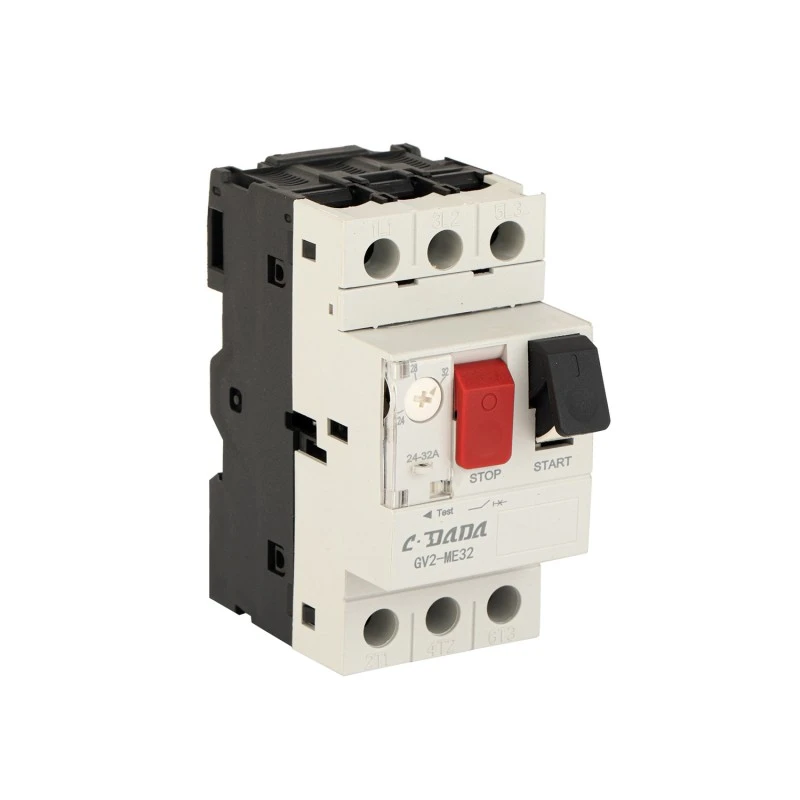
GV2 2P Motor Protection Circuit Breaker
Welcome to get advanced GV2 2P Motor Protection Circuit Breaker from CDADA, a reliable manufacturer and supplier in China. 0.1–32A, CE certified, with overload, short-circuit, phase-loss & isolation. Thermal compensation, 690V, 110k cycles. Ideal for compact motor control panels.
CDADA is a Motor Protection Circuit Breaker manufacturer and supplier in China. Our factory serves diverse industries such as power systems, building automation, and industrial manufacturing, offering flexible OEM/ODM solutions.