Residual Current Circuit Breaker Factory Direct Price
CDADA was established in 2004, though our origins date back to the 1980s. Drawing upon decades of specialized expertise, we have evolved into a mature and professional manufacturer and supplier of Residual Current Circuit Breakers. We invite you to partner with us to benefit from reliable technical support services and direct-from-factory pricing.
What is a Residual Current Circuit Breaker (RCCB)?
An RCCB is a specialized electrical safety device designed to disconnect a circuit whenever it detects a current imbalance between the live (phase) and neutral conductors. This imbalance, known as residual current or leakage current, indicates that electricity is flowing through an unintended path—potentially through a human body or deteriorating insulation.
Unlike an MCB or MCCB, an RCCB does not provide overload or short-circuit protection on its own (unless combined with them in an RCBO). Its sole purpose is life safety and fire prevention. It operates based on Kirchhoff’s Current Law, where the sum of currents entering a junction must equal the sum of currents leaving it. If the "in" and "out" currents differ by more than the device's sensitivity (e.g., 30mA), the RCCB trips.
Types and Classifications
Our manufacturing portfolio covers a wide range of RCCB types to suit diverse electrical environments, from single-phase homes to complex three-phase industrial grids.
|
Type |
Poles / Configuration |
Key Features |
Typical Application |
|
Type AC |
2-Pole (1P+N) / 4-Pole (3P+N) |
Detects sinusoidal AC residual currents. |
General residential and commercial lighting/power circuits. |
|
Type A |
2-Pole / 4-Pole |
Detects AC and pulsating DC residual currents. |
Circuits with electronic loads (washing machines, computers, dimmers). |
|
Type F |
2-Pole / 4-Pole |
Detects AC, pulsating DC, and composite multi-frequency currents. |
Specialized circuits with variable speed drives (VSD) and Class I appliances. |
|
Type B |
4-Pole |
Detects all Type A/F currents plus smooth DC residual currents. |
Three-phase EV charging stations, solar inverters, and medical equipment. |
Core Functions and Intelligent Protection
The heart of our RCCB is the Zero-Sequence Current Transformer (Toroid). This component continuously monitors the magnetic field generated by the current flow.
Leakage Detection: Under normal conditions, the magnetic fields of the Live and Neutral currents cancel each other out. If a leakage path to earth occurs (e.g., a person touches a live wire), the balance is broken.
Rapid Disconnection: The transformer detects this "residual" flux and induces a voltage in its secondary winding. This signal is amplified (in electronic types) or directly actuates a sensitive relay (in electromagnetic types), causing the mechanical latch to release and open the contacts.
Sensitivity Ratings:
High Sensitivity (10mA - 30mA): For direct contact protection (human safety). Mandatory for bathrooms, sockets, and outdoor circuits.
Medium Sensitivity (100mA - 300mA): For indirect contact protection and fire prevention. Used in main distribution boards to protect cables from insulation faults.
Primary Applications and Use Cases
Residential Safety: Mandatory installation in bathrooms, kitchens, and outdoor outlets to prevent fatal shocks from appliances like hair dryers or power tools.
Industrial Machinery: Protecting operators from electric shock when handling metal-cased equipment or portable tools.
Healthcare Facilities: Ensuring patient safety in hospitals where even minor leakage currents can be fatal (using Type B or specialized medical IT systems).
Renewable Energy: Protecting DC and AC sides of solar PV systems and EV charging stations from ground faults.
Precision Manufacturing: From Raw Material to Finished Product
Our production process is a symphony of precision magnetics and mechanical engineering.
1. Main Raw Materials:
Zero-Sequence Transformer Core: Made from high-permeability Permalloy (Nickel-Iron alloy) or Nanocrystalline strips. This material is crucial for detecting minute leakage currents without saturation.
Trip Relay/Solenoid: A highly sensitive polarized relay that converts the electrical signal from the transformer into mechanical movement.
Housing: Flame-retardant Polycarbonate (PC) or Nylon (PA66), designed to be non-conductive and impact-resistant.
Contacts: Silver-Cadmium-Oxide (AgCdO) or Silver-Nickel (AgNi) for reliable switching and low resistance.
2. Production & Processing Workflow:
Toroid Winding: The precision transformer core is wound with thousands of turns of ultra-fine copper wire. This must be done with extreme care to avoid shorting the turns.
Core Encapsulation: The magnetic core is encapsulated in epoxy resin to protect it from vibration and humidity, ensuring long-term stability.
Assembly: The toroid is placed around the conductor path (or the conductors pass through it). The trip mechanism is linked to the main contact latch.
Calibration (Sensitivity Setting): This is the most critical step. We use precision current sources to inject a leakage current (e.g., 30mA). The trip coil is mechanically adjusted until it activates exactly at the threshold.
Rigorous Quality Control and Testing Standards
We adhere to IEC/EN 62423 and IEC/EN 61008 standards. Our testing regime is designed to ensure the device trips only when it should, and always when it must.
Standard Test Items & Factory Inspection Criteria:
|
Test Item |
Standard Reference |
Our Factory Standard & Method |
|
Trip Current Test |
Verifies sensitivity (IΔn). |
Inject current at 1.0 x IΔn (must trip < 300ms) and 0.5 x IΔn (must NOT trip). |
|
Time Delay Test |
Verifies speed of operation. |
Inject 5 x IΔn (e.g., 150mA). The device must trip in < 40ms (General Type) or within specified time for Type S (Selective). |
|
Dielectric Strength |
Verifies isolation. |
Applied 2000V AC for 1 minute between input/output terminals and frame. No breakdown. |
|
Mechanical Operation |
Verifies latch durability. |
2,000 cycles of ON/OFF operation without failure. |
|
Short-Circuit Withstand |
Verifies survival capability. |
The RCCB must withstand a short-circuit current (e.g., 3kA or 6kA) without exploding or catching fire (verified by fuse protection). |
Our Production Prowess: Line, Equipment, and Team
Our facility is equipped to handle the delicate nature of magnetic sensing components.
Production Line: We utilize automated toroidal winding machines that ensure consistent turn counts and tension, which is vital for accurate current sensing.
Advanced Equipment:
Precision Leakage Current Calibrators: High-accuracy instruments capable of generating leakage currents with a resolution of 0.1mA for fine-tuning trip settings.
Magnetic Shielding Chambers: Used during assembly to prevent external magnetic fields from interfering with the sensitive calibration process.
Automatic Test Benches: 100% of units undergo a functional trip test before packaging.
Expert Team:
Magnetic Engineers: Specialists in designing the geometry of the zero-sequence transformer to maximize sensitivity.
Calibration Technicians: Highly trained staff who manually verify the trip thresholds of sensitive models.
Quality Assurance: Dedicated to analyzing failure modes and ensuring the reliability of the trip mechanism.
Choose our Residual Current Circuit Breakers. We don't just manufacture switches; we engineer the peace of mind that comes from knowing your circuit is watching your back.


- View as
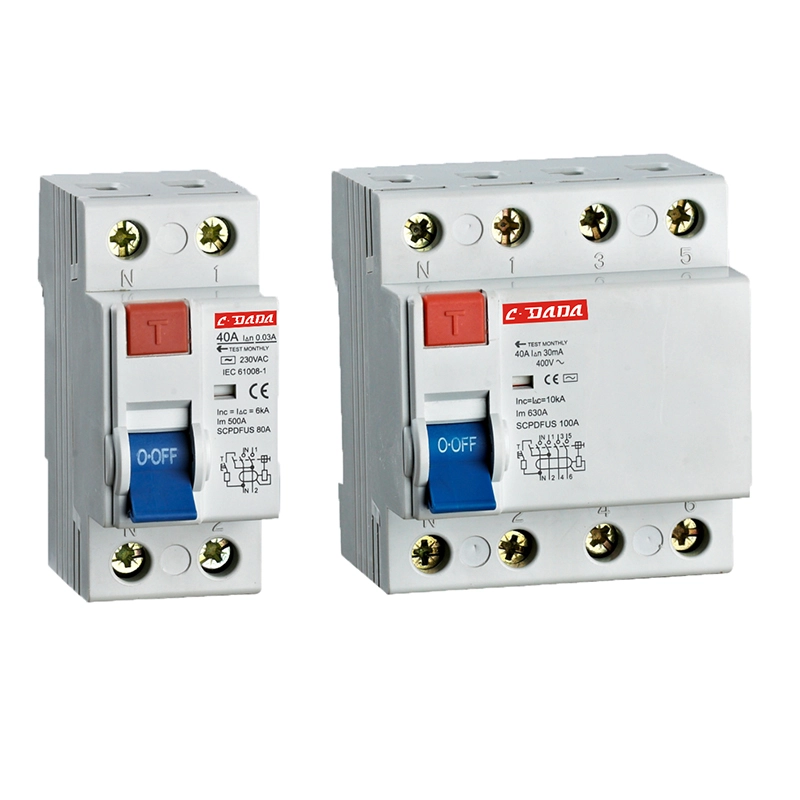
Electromagnetic Residual Current Circuit Breaker
As a reliable manufacturer, CDADA's Electromagnetic Residual current circuit breaker is IEC 61008-1 certified, 2P/4P, 16–100A, 10/30/100mA. Pure electromagnetic trip: no auxiliary power needed. IP20, 6kA, DIN rail. Ideal for harsh or unstable power environments.
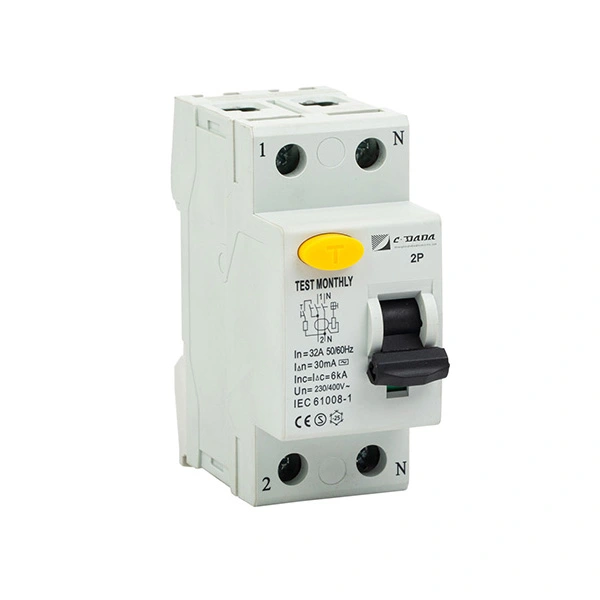
Type A Residual Current Circuit Breaker
Buy CDADA Type A Residual Current Circuit breaker from Shanghai DADA Electric, we have over 40 years of experience, can be your supplier. EN/IEC 61008-1 certified, 2P/4P, 16–100A, 30mA/100mA options. Detects AC + pulsating DC leakage. IP20, DIN rail mount, surge-resistant. Ideal for modern homes & commercial panels.
CDADA is a Residual Current Circuit Breaker manufacturer and supplier in China. Our factory serves diverse industries such as power systems, building automation, and industrial manufacturing, offering flexible OEM/ODM solutions.